Rockford's pest year follows its weather. The National Weather Service puts the city's average daily temperature at 21.8°F in January and 73.8°F in July, and that 52-degree swing decides when mosquitoes breed, when ticks quest, when termites swarm and when mice start looking for a way inside. The average first fall freeze arrives on October 13, and from there Rockford averages more than 18 freezing nights in November alone. Bed bugs are the exception: they live indoors all year, yet their reports still rise and fall with the seasons.
- Rockford's average first fall freeze is October 13 and its average last spring freeze is April 27, based on 1991–2020 data (NWS Chicago).
- The city averages 135.8 nights a year at or below 32°F, including 29.2 in January and 18.0 in November (NWS normals).
- Rodents infest approximately 21 million U.S. homes each winter (NPMA).
- A Census Bureau model estimates about 20,000 Winnebago County homes had a rodent sighting in a 12-month period, out of 125,708 housing units (U.S. Census Bureau, 2019 AHS).
- Illinois logged 150 human West Nile virus cases and 10 deaths in 2025, with 3,992 positive mosquito batches (IDPH).
- Illinois' first West Nile-positive mosquito batch of 2025 was collected in Rockford on May 9 (IDPH).
- Ticks are most active from April to September, though exposure can happen year-round (CDC); IDPH notes ticks can be active on winter days near 45°F.
- Winnebago County averaged 16.2 Lyme disease cases a year from 2018 to 2022, peaking at 24 in 2021 (IDPH).
- Mosquito barrier spray costs $70–$150 a visit, and seasonal packages run $600–$1,200 (Angi).
- Termites cause an estimated $6.8 billion in U.S. property damage a year (NPMA, 2026), and Illinois swarms are most common in spring (Illinois Extension).
- Brown recluse spiders live in the southern two-thirds of Illinois, a range that does not normally reach Rockford (Illinois DNR).
- Bed bug reports in a Philadelphia study peaked in August and hit their low in February each year (Journal of Medical Entomology).
- 51% of pest professionals say bed bugs are most active in summer (NPMA/University of Kentucky survey), and Chicago ranks #1 on Orkin's 2026 Bed Bug Cities list (Orkin).
1. Rockford's Climate by Month: The NOAA Baseline
Every date in this calendar starts from the official 1991–2020 climate normals for the Rockford airport station, published by the National Weather Service office in Chicago. Humidity is not part of the standard normals, so the humidity rows come from NOAA's Comparative Climatic Data, which reports long-term average morning and afternoon relative humidity for first-order stations including Rockford.
| Month | Avg high / low | Avg temp | Precip. | Humidity AM / PM | Nights ≤ 32°F |
|---|---|---|---|---|---|
| January | 29.1° / 14.5° | 21.8°F | 1.60 in. | 79% / 72% | 29.2 |
| February | 33.4° / 17.8° | 25.6°F | 1.63 in. | 80% / 70% | 25.8 |
| March | 46.5° / 28.1° | 37.3°F | 2.40 in. | 79% / 66% | 21.9 |
| April | 59.7° / 38.5° | 49.1°F | 3.75 in. | 76% / 61% | 7.4 |
| May | 71.2° / 49.5° | 60.4°F | 4.18 in. | 80% / 62% | 0.6 |
| June | 80.7° / 59.6° | 70.1°F | 5.23 in. | 81% / 63% | 0 |
| July | 83.9° / 63.6° | 73.8°F | 3.81 in. | 85% / 66% | 0 |
| August | 82.0° / 61.8° | 71.9°F | 4.19 in. | 88% / 67% | 0 |
| September | 75.3° / 53.5° | 64.4°F | 3.62 in. | 86% / 66% | 0.3 |
| October | 62.3° / 41.8° | 52.0°F | 2.63 in. | 83% / 64% | 5.3 |
| November | 47.1° / 30.5° | 38.8°F | 2.27 in. | 81% / 70% | 18.0 |
| December | 34.3° / 20.2° | 27.3°F | 1.93 in. | 82% / 74% | 27.3 |
| Year | 58.8° / 40.0° | 49.4°F | 37.24 in. | 82% / 67% | 135.8 |
Temperature, precipitation and freezing-night counts are from the NWS Chicago 1991–2020 normals for Rockford; humidity is from NOAA's Comparative Climatic Data (data through 2009). June is Rockford's wettest month at 5.23 inches, and August has the highest average morning humidity at 88 percent.
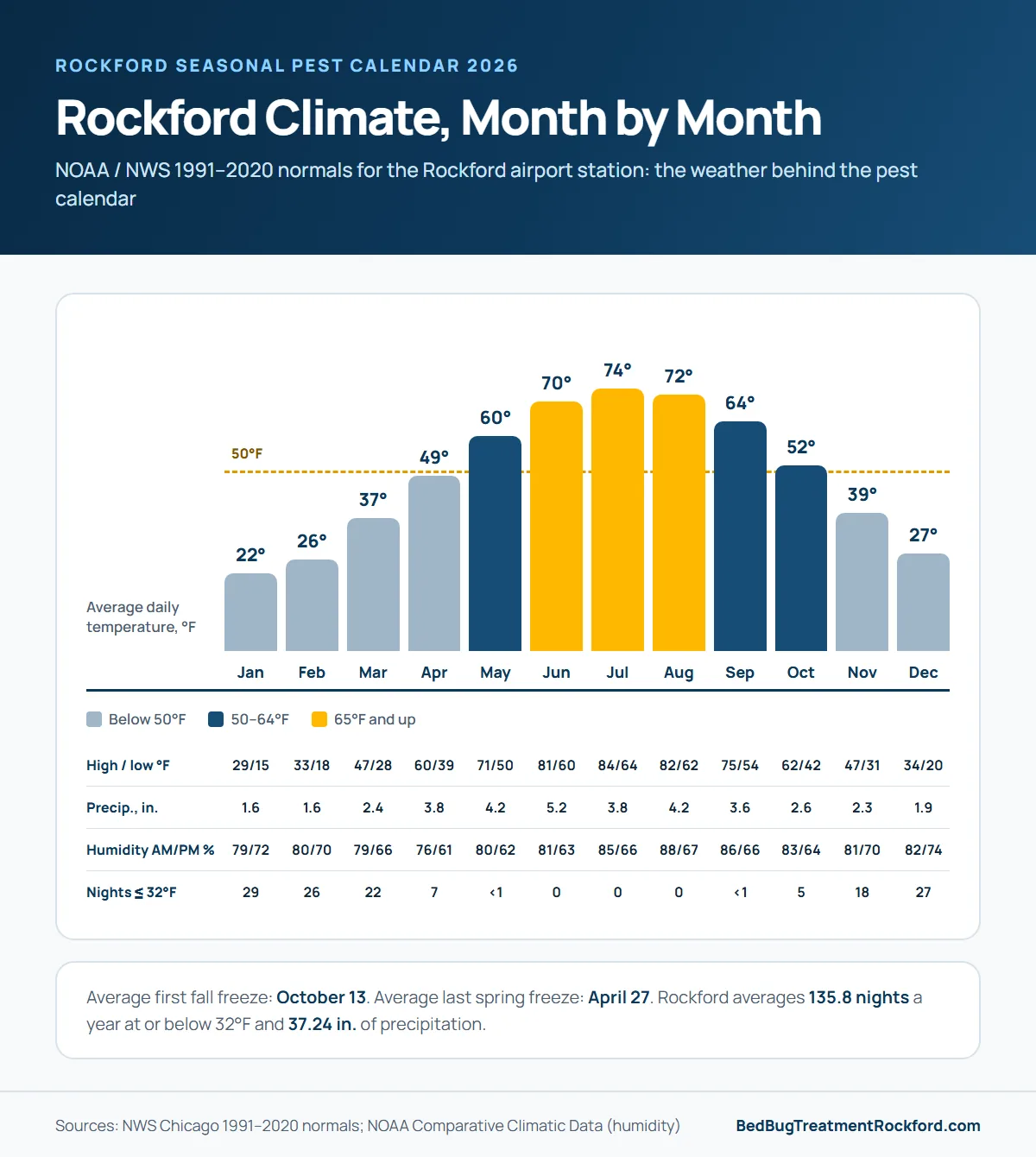
The freeze records show how much a single year can drift. Rockford's earliest first fall freeze came on September 13, 1975 and the latest on November 11, 2016; in 2025 the first freeze arrived on October 23 at 30°F. The latest last spring freeze on record was May 27, 1992. A warm October can push the rodent surge back by weeks, and a late May frost can delay the start of mosquito season.
2. The 12-Month Rockford Pest Pressure Matrix
The matrix below lines each pest's documented window up against Rockford's monthly temperature and humidity. "Active" months fall inside the window an agency or study publishes. "Peak" marks the months a source identifies as heaviest, or, for mosquitoes, the months when Rockford's average temperature is 65°F or higher, inside Climate Central's 50–95°F "mosquito day" band. "Watch" marks the edges of a window. It is an editorial index, not a count of infestations.
| Pest | Jan | Feb | Mar | Apr | May | Jun | Jul | Aug | Sep | Oct | Nov | Dec |
|---|---|---|---|---|---|---|---|---|---|---|---|---|
| Avg temp (°F) | 22 | 26 | 37 | 49 | 60 | 70 | 74 | 72 | 64 | 52 | 39 | 27 |
| AM humidity (%) | 79 | 80 | 79 | 76 | 80 | 81 | 85 | 88 | 86 | 83 | 81 | 82 |
| Mosquitoes | – | – | – | Watch | Active | Peak | Peak | Peak | Active | Watch | – | – |
| Ticks | – | – | Watch | Active | Peak | Peak | Active | Active | Active | Active | Watch | – |
| Termite swarms | – | – | – | Active | Peak | Active | Watch | Watch | Watch | – | – | – |
| Fall invaders (lady beetles, boxelder bugs, stink bugs) | Watch | Watch | Watch | – | – | – | – | – | Active | Peak | Active | Watch |
| Rodents moving indoors | Peak | Active | Active | Watch | – | – | – | – | Watch | Active | Peak | Peak |
| Bed bugs (indoors) | Watch | Watch | Watch | Watch | Active | Peak | Peak | Peak | Active | Active | Active | Active |
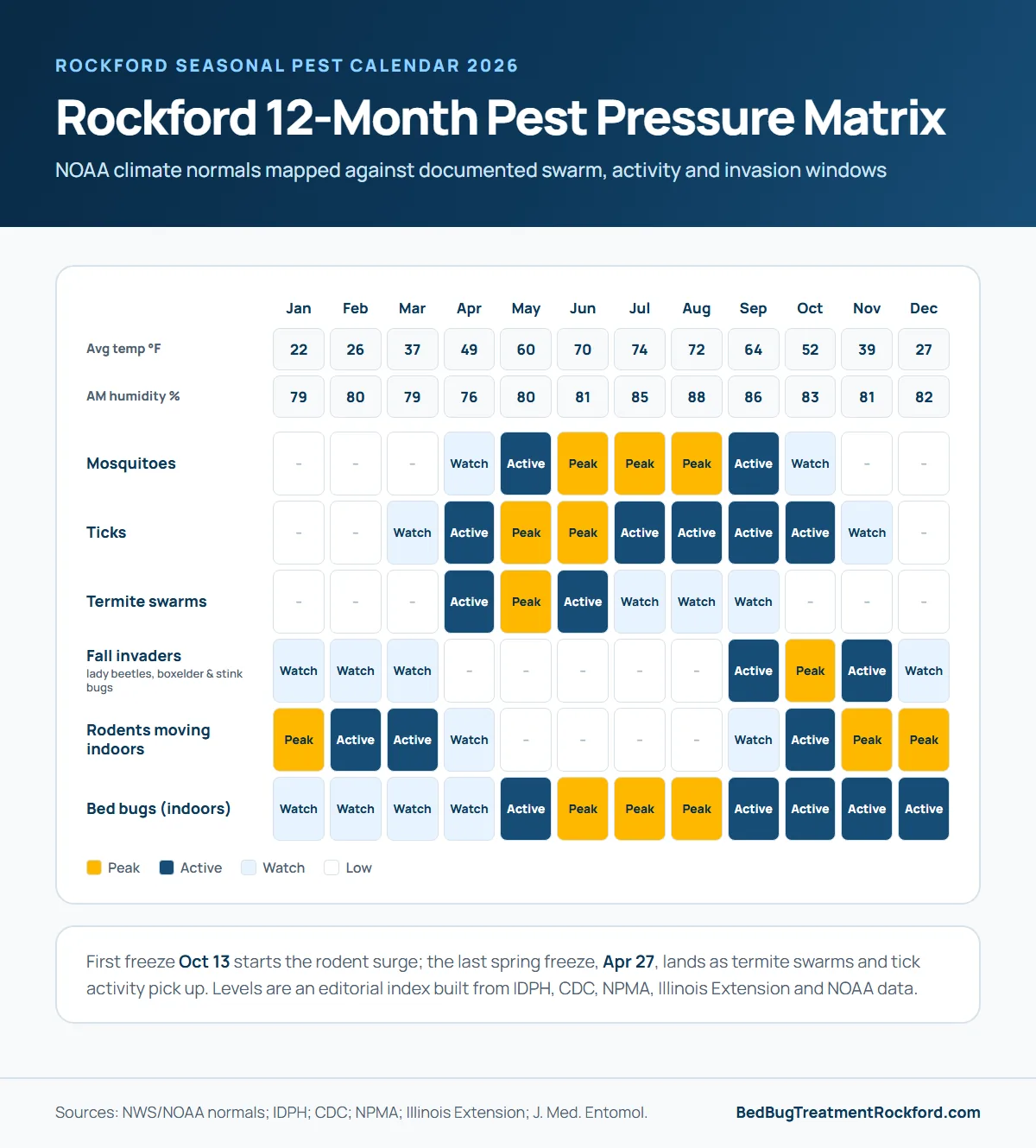
Read across a row and the season for each pest is clear. Read down a column and you see what a given month asks of a Rockford household: in May, check the foundation for termite swarmers and yourself for ticks; in October, seal gaps before the first freeze sends mice and lady beetles looking for a way in; in July and August, watch for mosquitoes outdoors and for bed bugs coming home in luggage.
3. The Most Common Seasonal Pests in Rockford
No public survey ranks pests for Rockford specifically. What does exist is a set of agency and university sources that document which pests are established in northern Illinois and when they turn up. The table below collects them.
| Pest | Rockford season | What the data says | Source |
|---|---|---|---|
| Mosquitoes (Culex) | May–Oct | West Nile surveillance runs May 1 to Oct 15; Rockford had the state's first positive batch of 2025 | IDPH |
| Blacklegged ticks | Apr–Sep, plus mild days | Common mostly in northern Illinois; found in 24 of 42 surveyed counties | IDPH, INHS |
| Subterranean termites | Spring swarms | Swarms common in spring, possible in most warm months | Illinois Extension |
| Lady beetles, boxelder bugs, stink bugs | Sep–Nov | Move to walls on warm fall days around 64°F | Illinois Extension |
| House mice and rats | Oct–Mar | Invade in fall and winter as the climate cools | NPMA |
| Bed bugs | All year, summer peak | Indoor pest; reports peak in August | J. Med. Entomol. |
| Brown recluse spiders | Rare this far north | Range is the southern two-thirds of Illinois | Illinois DNR |
Two national datasets add context on how common the indoor pests are. The Census Bureau's American Housing Survey found 14.8 million homes saw rodents and 14 million saw cockroaches in the prior 12 months in 2019. NPMA reports that nearly one-third of Americans have had a rodent problem at home. For what each of these pests costs to treat in Rockford, see the Rockford pest control cost index.
4. Spring: When Do Termites Swarm in Rockford?
Eastern subterranean termites send out winged swarmers to start new colonies. University of Illinois Extension says swarms are common to see in the spring but can happen during most warm months of the year in Illinois. In Rockford terms, that puts the main swarm window after the April 27 average last freeze, when average temperatures climb from 49°F in April to 60°F in May and rainfall rises from 3.75 to 4.18 inches.
| Termite metric | Value | Source |
|---|---|---|
| U.S. property damage a year | $6.8 billion (estimate) | NPMA, 2026 |
| Homeowners who know the damage termites can cause | 58% | NPMA / Harris Poll |
| Homeowners who know the signs of termites | 36% | NPMA / Harris Poll |
| Homeowners who think prevention costs less than repair | 45% | NPMA / Harris Poll |
| U.S. homes damaged by termites a year | ~600,000 | Orkin |
| Rockford average temperature, April / May | 49.1°F / 60.4°F | NWS |
The Harris Poll behind NPMA's numbers surveyed 2,087 U.S. adults in early 2026, and it shows that most homeowners would not recognize a swarm. Swarmers are often mistaken for flying ants. A cluster of discarded wings on a windowsill in late April or May is the classic sign, and it is worth a professional look even though termite treatment is outside what this bed bug site covers.
5. When Is Mosquito Season in Illinois?
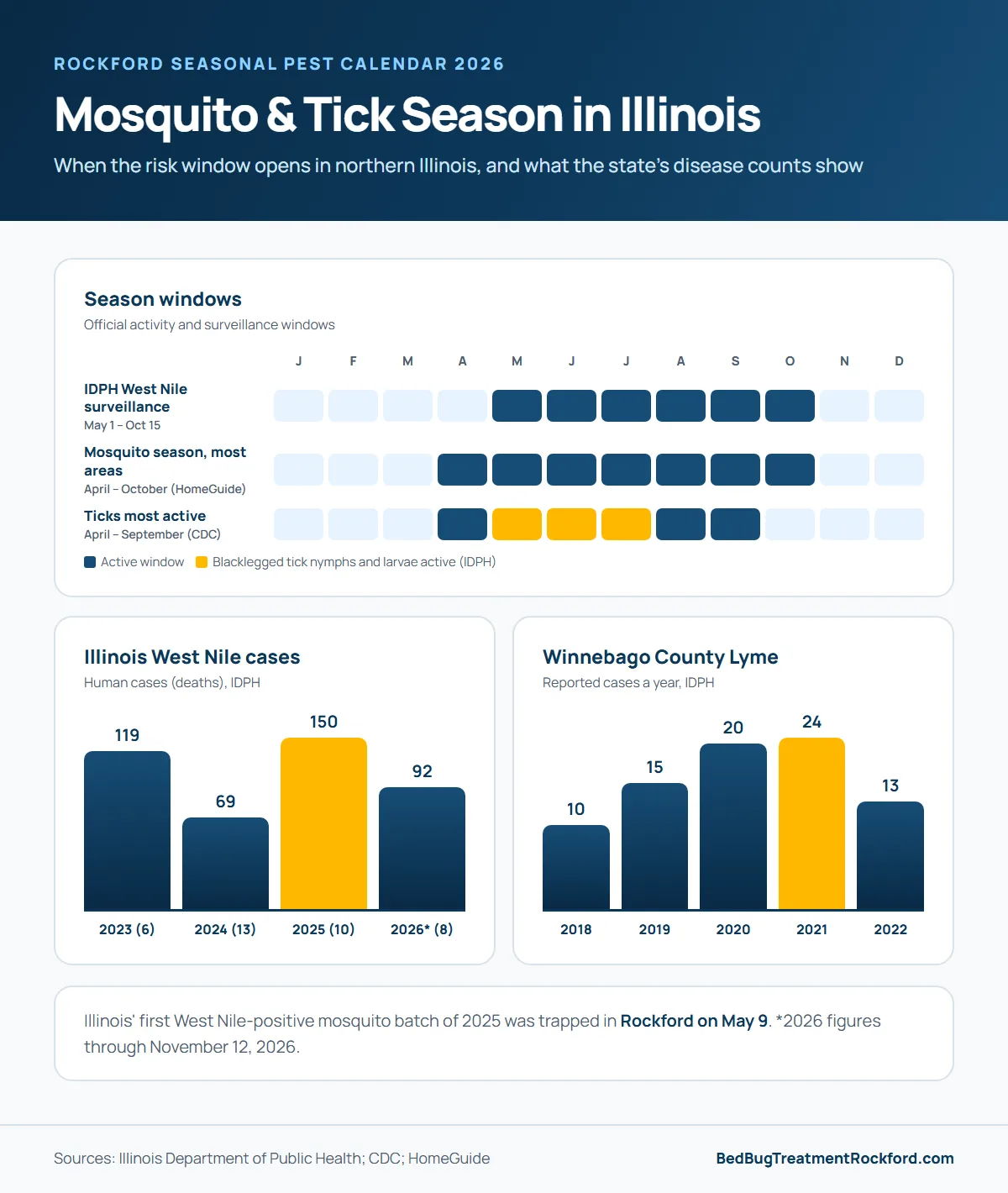
The state's own surveillance calendar is the clearest answer. Local health departments collect dead birds for West Nile testing each season from May 1 to October 15, and the Culex "house mosquito" that carries the virus is the species IDPH tracks. Rockford sits at the front of that season: the Winnebago County Health Department trapped Illinois' first positive batch of 2025 on May 9 in Rockford.
| Year | Human cases | Deaths | Positive mosquito batches | Counties with positives |
|---|---|---|---|---|
| 2023 | 119 | 6 | 3,388 | 67 |
| 2024 | 69 | 13 | 3,108 | 72 |
| 2025 | 150 | 10 | 3,992 | 73 |
| 2026 (through Nov 12) | 92 | 8 | 3,587 | 61 |
In 2026 the first positive batches turned up in Cook County in May, and by late August 50 counties had positives and IDPH had awarded $2.8 million to 97 local health departments for mosquito control. Temperature drives the season: Climate Central counts a "mosquito day" when temperatures stay between 50°F and 95°F with humidity of 42% or more. Rockford's average temperature first passes 50°F in May and drops back near it in October, and its afternoon humidity never averages below 61 percent.
6. When Is Tick Season in Illinois?
The CDC says ticks are most active during warmer months (April–September) but that exposure can occur year-round. IDPH adds the local detail: ticks can be active on winter days when ground temperatures are about 45°F, blacklegged tick larvae and nymphs are active in spring and early summer, adults in spring and fall, and the species is common mostly in northern Illinois. Rockford's average high reaches 46.5°F in March, so the tick year can start before spring officially does.
| Year | Winnebago County cases | Winnebago rate per 100,000 | Illinois cases |
|---|---|---|---|
| 2018 | 10 | 3.4 | 276 |
| 2019 | 15 | 5.1 | 395 |
| 2020 | 20 | 7.0 | 295 |
| 2021 | 24 | 8.4 | 540 |
| 2022 | 13 | 4.6 | 259 |
| 5-year average | 16.2 | 5.7 | 353 |
All figures are from IDPH's five-year Lyme disease table by county, the most recent county-level release; the Illinois average is calculated from it. Nearby counties run higher or lower: Boone County averaged 5.2 cases per 100,000, Ogle 6.9 and Jo Daviess 44.0, the highest in the state. University of Illinois researchers found blacklegged ticks in 24 of 42 northern and central Illinois counties they surveyed, with about 39 percent of tested ticks carrying the Lyme bacterium.
7. Mosquito Barrier Spray Costs for a Rockford Season
Barrier spray is the standard yard treatment: a technician sprays shrubs, fences and shaded resting spots, and the product keeps working for a few weeks. HomeGuide says a treatment lasts 3 to 4 weeks and that mosquito season runs from April to October in most areas. Here is what the national cost guides publish.
| Mosquito service | Published cost | Source |
|---|---|---|
| Barrier spray, per visit | $70–$150 | Angi |
| Treatment, per visit | $80–$150 | HomeGuide |
| Average visit | about $136 | Lawn Love |
| One-time event treatment | $150–$300+ | HomeGuide |
| About 3 treatments a year, near water or woods | $330–$495 | Lawn Love |
| Monthly program | $500–$1,000 | Angi |
| Seasonal package | $600–$1,200 | Angi |
| Rockford May–September, 5 visits (calculated) | $400–$750 | HomeGuide per-visit range × 5 |
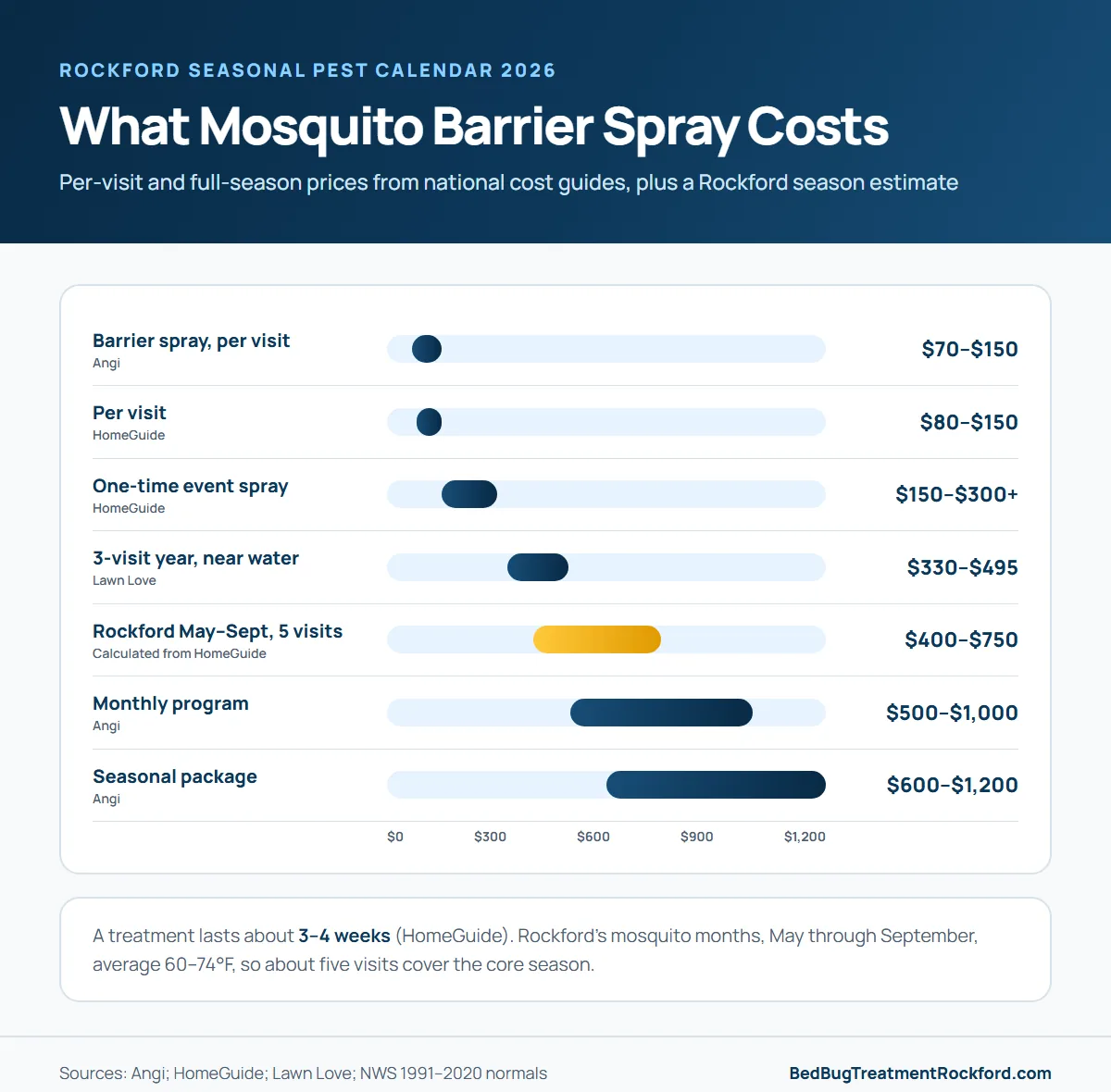
The often-quoted "$75–$150 a visit" holds up against these guides. A flat "$350–$700 a season" is too narrow: published season prices run from about $330 for three visits to $1,200 for a full package. For Rockford, a monthly visit from May through September, the months when the average temperature is above 60°F, is five visits, which works out to $400–$750 at HomeGuide's per-visit rates. Angi's overall average is $350 per treatment or season, with most homeowners spending $200 to $550. Mosquito spraying is outdoor work and is priced separately from indoor pest plans; the cost-by-pest table in our price index puts general mosquito service at $350–$500.
8. Fall Invaders: Lady Beetles, Boxelder Bugs and Stink Bugs
Before the rodents come the insects that overwinter in walls. University of Illinois Extension says multicolored Asian lady beetles hunt for overwintering sites on warm days around 64°F that follow near-freezing temperatures. In Rockford, September averages 64.4°F and October 52.0°F, with the first freezing nights arriving in October, so those triggers line up in late September and October.
| Fall invader | Trigger or timing | Source |
|---|---|---|
| Multicolored Asian lady beetle | Warm days near 64°F after near-freezing nights | Illinois Extension |
| Boxelder bug | Seeks warmth as fall temperatures cool; favors south- and west-facing walls | Illinois Extension |
| Brown marmorated stink bug | Gathers on sunny walls in fall; on the rise in Illinois | Illinois Extension |
| Lady beetles and stink bugs on houses | Mid-October described as "that time of year" | Illinois Extension |
| Cluster flies | Overwinter in attics and wall voids; emerge on sunny midwinter days | Illinois Extension |
These insects do not breed indoors or damage the house, but they explain why some Rockford homes see bugs on windows in January and February: overwintering insects warm up inside the walls and wander into living space. Sealing gaps around windows, siding and utility lines in September keeps them out, and the same work blocks the mice that follow a few weeks later.
9. The Winter Rodent Surge: First Frost to March
NPMA puts the national figure plainly: rodents infest approximately 21 million U.S. homes each winter, and they typically invade during fall and winter in search of food and shelter as the climate cools. In Rockford, the cooling has a date. Freezing nights average 0.3 in September, 5.3 in October after the October 13 first freeze, then jump to 18.0 in November and 27.3 in December.
| Rodent metric | Value | Source |
|---|---|---|
| U.S. homes infested by rodents each winter | ~21 million | NPMA |
| U.S. homes that saw rodents in the past 12 months (2019) | 14.8 million (11.9%) | Census AHS |
| Metro range for rodent sightings (2019) | 3.1% (Phoenix) to 18.9% (Philadelphia) | Census AHS |
| Winnebago County homes with a rodent sighting in 12 months | ~19,950 (90% CI 9,470–30,440) | Census model, 2019 |
| Winnebago County housing units (2019) | 125,708 | Census PEP |
| Americans who have had a rodent problem at home | nearly 1 in 3 | NPMA |
| Gap a mouse can fit through | 1/4 inch (about a dime) | NPMA |
| Young a female mouse can have | up to 12 every 3 weeks | NPMA |
| Chicago on Orkin's Rattiest Cities list, 2026 | #2 (Springfield, Ill. #29) | Orkin |
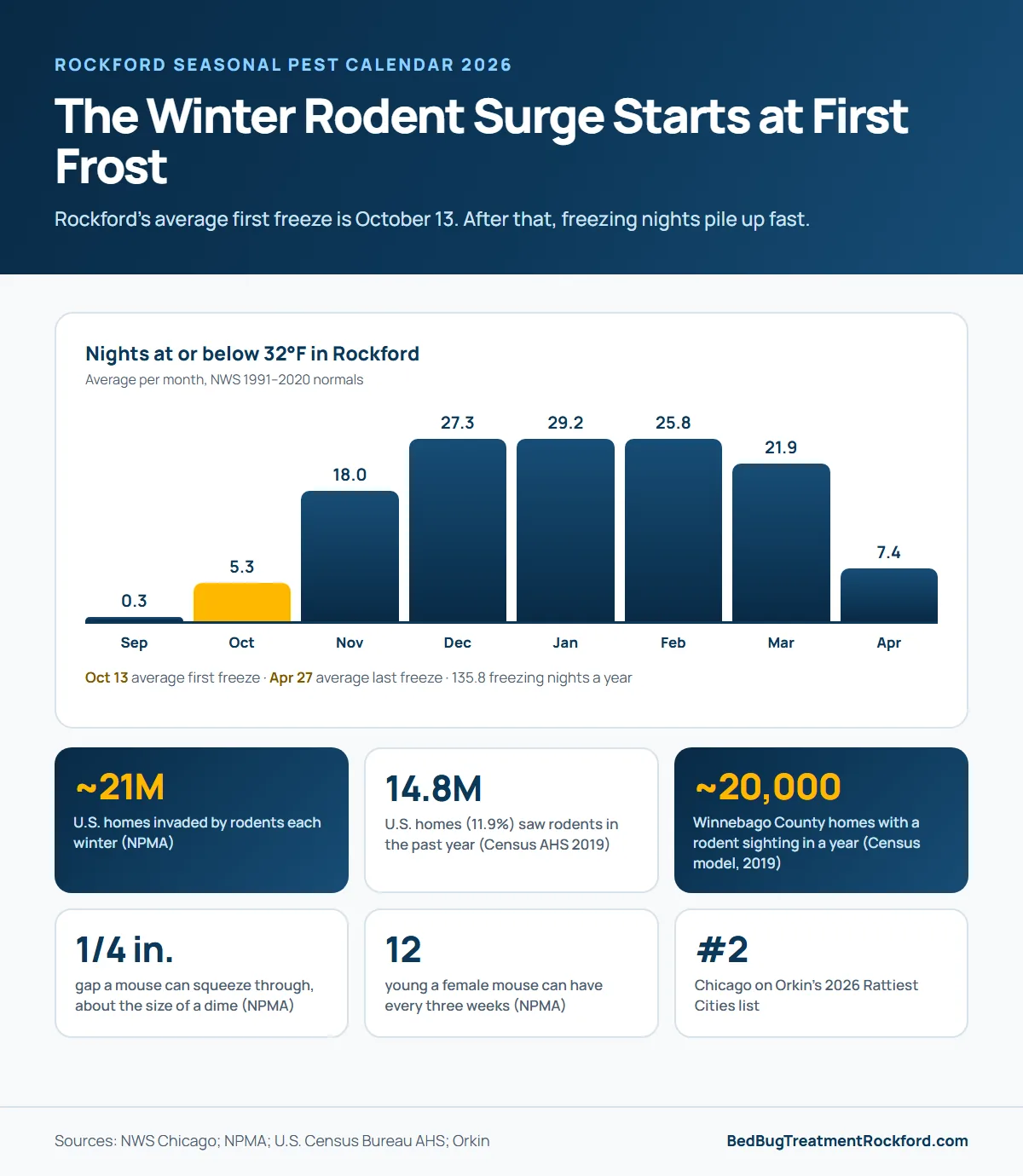
The NPMA figure counts winter infestations nationally; the Census numbers count any rodent sighting over a full year, so the two are not directly comparable, but both point the same way. The practical window for Rockford is late September to mid-October, before the first freeze: a mouse needs only a quarter-inch gap, so sealing around pipes, vents and garage doors then does more than trapping in January.
10. Brown Recluse Spiders in Illinois: How Far North?
Brown recluse spiders are native to Illinois, but the Illinois Department of Natural Resources places them in the southern two-thirds of the state. A distribution study found them common in southern Illinois and dwindling to almost nonexistence toward the northern counties. Rockford, in Winnebago County on the Wisconsin line, is outside that established range, so a brown spider found here is far more likely to be another species.
| Brown recluse fact | Value | Source |
|---|---|---|
| Illinois range | Southern two-thirds of the state | Illinois DNR |
| Northern Illinois counties | Almost nonexistent | Cramer, 2014 |
| Recluses collected in one Kansas home in 6 months | 2,055, with no bites to residents | Vetter, 2002 |
| Seasonal cycle | Egg sacs in fall; outdoor females die with cold; eggs hatch in spring | Illinois DNR |
The Kansas case is the useful reality check: even a house with more than 2,000 recluses produced no bites over six months, which is why entomologists push back on brown recluse bite diagnoses outside the spider's range. The same caution applies to bed bugs. The University of Minnesota reports that 76% of samples sent in as suspected bed bugs turned out to be something else, so an inspection that confirms the insect should come before any treatment.
11. Bed Bug Seasonality: Summer Surge, Holiday Travel, Winter Clustering
Bed bugs do not follow the outdoor calendar the way mosquitoes or mice do. They live indoors next to people, so a heated Rockford home suits them in January as well as in July. Their reports still have a season, though. A study of Philadelphia's pest control records logged 382 bed bug reports from December 2008 to May 2011 and found reports peaking in August and reaching a low in February every year, while the total climbed about 4.5 percent a month. The authors suggest that warmer temperatures speed up bed bug metabolism and movement.
| Bed bug seasonality metric | Value | Source |
|---|---|---|
| Peak month for bed bug reports (Philadelphia) | August; low in February | Mabud, Levy et al., 2014 |
| Share of all pest reports that were bed bugs, 2011–2012 | 47% (236 of 497) | Mabud, Levy et al., 2014 |
| Pros who say bed bugs are most active in summer | 51% | NPMA / Univ. of Kentucky, 2018 |
| Pros who found bed bugs in single-family homes / apartments / hotels | 91% / 89% / 68% | NPMA / Univ. of Kentucky, 2018 |
| Infestations involving the primary bedroom | 94% | NPMA, 2025 |
| Pros who call bed bugs the hardest pest to control | 24% | NPMA, 2025 |
| Egg hatch time | 6–10 days | Univ. of Minnesota Extension |
| Survival without feeding at 55°F or below | up to a year or more | Univ. of Kentucky |
| Body temperature that kills bed bugs | 113°F (45°C) | EPA |
| Cold needed to kill adults / eggs at 32°F | 15 days / 30 days | IDPH |
The summer surge
Summer is when warmth, travel and moving season overlap. In NPMA's survey, pest professionals said bed bugs are most active during warmer months, especially summer, with slightly more service calls later in the season. Development is temperature-driven too: Virginia's agriculture department puts egg-to-adult at about 37 days at temperatures above 72°F, and Rockford's indoor summer, with outdoor highs of 81–84°F from June through August, keeps homes in that range. Summer is also when lease turnovers and secondhand furniture move between units, which is why apartment bed bug treatment calls often involve more than one unit.
Holiday and travel peaks
Bed bugs hitchhike in luggage, and travel now hits records every year. TSA screened more than 3.1 million people on Sunday, November 30, 2025, its busiest day ever, and AAA forecast a record 81.8 million Thanksgiving travelers and 122.4 million over the year-end holidays in 2025. Closer to home, Chicago Rockford International Airport set a passenger record of more than 310,000 travelers in 2025. EPA's advice after any trip is to unpack directly into the washing machine and dry on high heat, since washing alone generally does not kill bed bugs. If bites start a week or two after a trip, a bed bug inspection is the right first step.
Winter indoor clustering
Rockford's winters do nothing to slow an infestation that is already inside. With 135.8 freezing nights a year, households keep windows shut, heat on and guests in spare rooms, and bed bugs stay clustered around beds and couches where people sleep. Cold only works as a treatment when it is sustained: IDPH says it takes 15 days at 32°F to kill adults and 30 days for unprotected eggs, and leaving a couch on a Rockford porch for a few cold nights will not do it. Heat is the faster route: professional heat treatments typically run 140–150°F according to IDPH, and adults die after 90 minutes at a constant 113°F. That is why whole-home heat treatment works in any month, and chemical treatment plus a follow-up visit covers the eggs that hatch 6 to 10 days later.
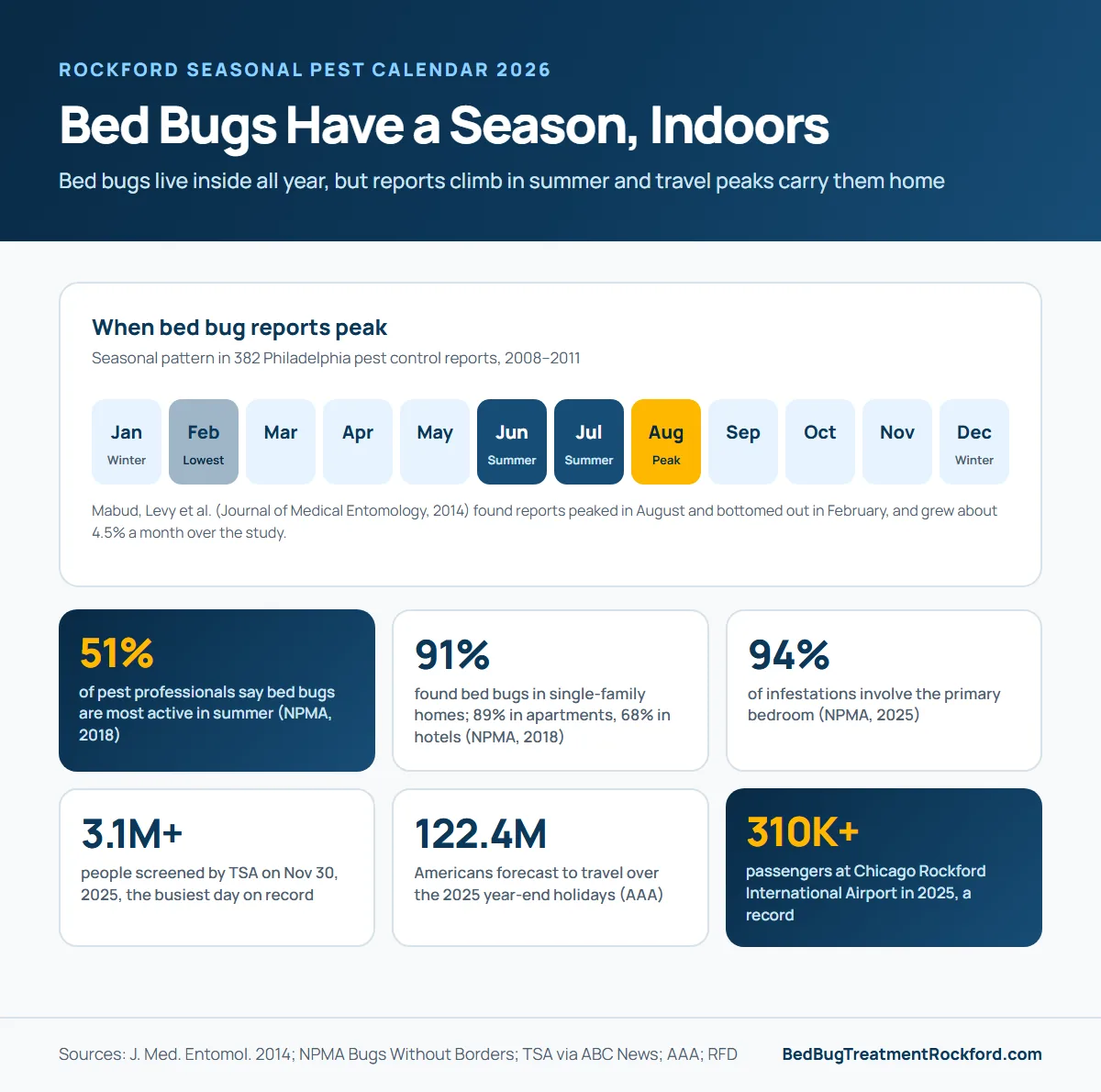
For Rockford households, the pattern means two checkpoints a year: late summer, after vacations and lease changes, and January, after holiday travel and houseguests. Older neighborhoods with shared walls, such as Haight Village and Brown's Hills-Knightsville, see the same routes in every month. The bed bug section of our cost index lists what inspection, heat and chemical treatment cost.
Rockford Seasonal Pest Statistics Summary Table
| Statistic | Value | Source |
|---|---|---|
| Average first fall freeze / last spring freeze | Oct 13 / Apr 27 | NWS Chicago |
| Freezing nights a year | 135.8 | NWS Chicago |
| Warmest month (average temperature) | July, 73.8°F | NWS Chicago |
| Wettest month | June, 5.23 in. | NWS Chicago |
| Most humid month (morning) | August, 88% | NOAA CCD |
| West Nile surveillance season | May 1–Oct 15 | IDPH |
| Illinois West Nile cases, 2025 | 150 (10 deaths) | IDPH |
| Ticks most active | April–September | CDC |
| Winnebago County Lyme cases, 2018–2022 average | 16.2 a year | IDPH |
| Mosquito barrier spray, per visit | $70–$150 | Angi |
| Mosquito seasonal package | $600–$1,200 | Angi |
| Termite damage, U.S. per year | $6.8 billion | NPMA |
| U.S. homes infested by rodents each winter | ~21 million | NPMA |
| Winnebago County homes with rodent sightings | ~19,950 a year | Census model |
| Brown recluse range in Illinois | Southern two-thirds | Illinois DNR |
| Bed bug reports peak / low | August / February | J. Med. Entomol. |
| Pros saying bed bugs peak in summer | 51% | NPMA |
Methodology & Sources
This calendar was compiled in November 2026. Climate figures are the National Weather Service's 1991–2020 normals for the Rockford airport station; humidity comes from NOAA's Comparative Climatic Data (data through 2009), because humidity is not part of the standard normals. Pest windows come from IDPH, the CDC, Illinois DNR, University of Illinois Extension and the Illinois Natural History Survey, with national context from NPMA, the Census Bureau's American Housing Survey and peer-reviewed studies. The pest pressure matrix is an editorial index: a month is "Active" when it falls inside a published window, "Peak" when a source identifies it as heaviest (or, for mosquitoes, when Rockford's average temperature is 65°F or higher), and "Watch" at the edges. The starting brief's figures were checked against sources: the rodent figure is "approximately 21 million" rather than "21+ million", and the mosquito season range was widened to match published prices. Calculated figures are labeled. Rockford-specific pest surveys do not exist, so none is cited.
- NWS Chicago -- Rockford 1991-2020 normals
- NWS Chicago -- First freeze normals
- NWS Chicago -- Last freeze normals
- NOAA NCEI -- Comparative Climatic Data
- Climate Central -- Mosquito days, 2023
- IDPH -- West Nile virus at a glance
- IDPH -- Dead bird collection season
- IDPH -- First positive batch of 2025
- IDPH -- August 2026 West Nile update
- IDPH -- Lyme disease cases by county, 2018-2022
- IDPH -- Common ticks
- IDPH -- Bed bugs
- CDC -- Preventing tick bites
- CDC -- Lyme disease data and statistics
- INHS -- Illinois tick surveillance
- Angi -- Mosquito treatment cost, 2026
- HomeGuide -- Mosquito control cost
- Lawn Love -- Mosquito control cost
- Illinois Extension -- Termite troubles, 2024
- NPMA -- Termite survey, 2026
- Orkin -- Termite statistics
- Illinois Extension -- Asian lady beetles, 2024
- Illinois Extension -- Fall house guests
- Illinois Extension -- Nuisance invaders, 2017
- Illinois Extension -- Overwintering insects, 2017
- NPMA -- Rodents Revealed, 2020
- NPMA -- Rodents invading homes
- U.S. Census Bureau -- Homes with pests (AHS 2019)
- U.S. Census Bureau -- County rodent estimates, 2019
- Orkin -- 2026 Rattiest Cities
- Orkin -- 2026 Bed Bug Cities
- Illinois DNR -- Brown recluse
- Cramer -- Brown recluse distribution in Illinois, 2014
- Vetter -- 2,055 recluses in a Kansas home, 2002
- Mabud, Levy et al. -- Bed bug reports in Philadelphia, 2014
- NPMA / Univ. of Kentucky -- Bugs Without Borders, 2018
- NPMA -- Bugs Without Borders, 2025
- University of Minnesota Extension -- Bed bugs
- University of Kentucky -- Bed bugs
- VDACS -- Bed bug biology
- VDACS -- Bed bug heat treatment
- EPA -- Top ten tips for bed bugs
- EPA -- Bed bug tips for travel
- ABC News -- TSA record day, 2025
- AAA -- Thanksgiving forecast, 2025
- AAA -- Year-end forecast, 2025
- Chicago Rockford International Airport -- 2025 in review
Rockford Seasonal Pest FAQ
What are the most common pests in Rockford, IL?
Rockford's seasonal pests follow its climate: mosquitoes from May to October, blacklegged ticks from April to September, termite swarms in spring, lady beetles and boxelder bugs in fall, and mice and rats from the October 13 average first freeze through March. Bed bugs are an indoor pest present all year, with reports peaking in summer. No public survey ranks pests for Rockford alone.
When is mosquito season in Illinois?
The Illinois Department of Public Health runs West Nile virus surveillance from May 1 to October 15, and HomeGuide puts mosquito season at April to October in most areas. In Rockford, the average temperature passes 50 degrees F in May. Illinois' first positive mosquito batch of 2025 was collected in Rockford on May 9.
When is tick season in Illinois?
The CDC says ticks are most active from April to September, but exposure can happen year-round. IDPH notes ticks can be active on winter days when ground temperatures are about 45 degrees F. Blacklegged tick nymphs are active in spring and early summer, and adults in spring and fall.
When do termites swarm in Rockford?
University of Illinois Extension says termite swarms are common in spring and can happen during most warm months in Illinois. In Rockford that usually means after the April 27 average last freeze, as average temperatures rise from 49 degrees F in April to 60 degrees F in May.
How many homes do rodents invade in winter?
The National Pest Management Association says rodents infest approximately 21 million U.S. homes each winter. A Census Bureau model estimates about 20,000 Winnebago County homes had a rodent sighting in a 12-month period. Rockford's average first freeze is October 13, and freezing nights jump from 5.3 in October to 18 in November.
Are there brown recluse spiders in Rockford?
Rarely, if at all. The Illinois Department of Natural Resources places the brown recluse in the southern two-thirds of the state, and a distribution study found it almost nonexistent in the northern counties. Rockford, in Winnebago County on the Wisconsin line, is outside that established range.
How much does mosquito spraying cost per season?
Barrier spray costs $70 to $150 a visit according to Angi, and $80 to $150 according to HomeGuide. Angi lists seasonal packages at $600 to $1,200. Five monthly visits from May to September in Rockford work out to about $400 to $750 at HomeGuide's per-visit rates.
Do bed bugs have a season?
Bed bugs live indoors all year, but their reports are seasonal. A Philadelphia study found bed bug reports peaked in August and were lowest in February, and 51 percent of pest professionals in an NPMA survey said bed bugs are most active in summer. Holiday travel and winter houseguests keep them moving in colder months.